Rekey, replace, or upgrade
Most people ask to have locks replaced when a rekey is what they need. The two are different jobs, with different costs, solving different problems.
Rekeying keeps the hardware and changes which key turns it - the brass pins inside the cylinder are re-stacked to a new key. It fits a change of tenancy, a lost key, a contractor or former partner who may still hold a copy, or the wish to put several doors on one key.
Replacement changes the hardware itself. It fits a lock that is physically worn, damaged in a break-in, of too low a grade for an exterior door, or too old for parts.
Older housing, older hardware
A lot of Waterbury's housing predates the hardware standards now taken for granted, and two things follow. Mortise locks - the kind fitted into a pocket cut in the door rather than through a round bore - are still common in the city's older houses, and they are repaired and rekeyed rather than swapped for a modern deadbolt without altering the door. And a house that has been subdivided over the years usually carries several generations of lock on the same building, which is why one key for everything is such a frequent request here.
Smart locks and keypads
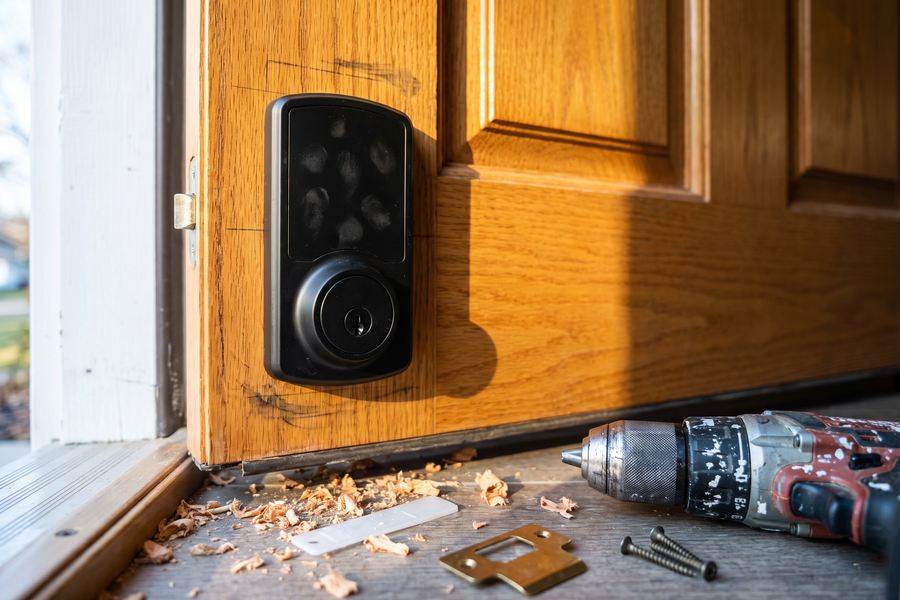
They fit most standard doors. Batteries fail and a dead battery is a lockout, so check for a physical key override. And codes need clearing when a tenant or guest leaves - the digital equivalent of a rekey, and just as easy to forget.
After a break-in
Damaged hardware gets replaced rather than rekeyed, and the frame matters as much as the lock. A forced door often means a split jamb or a strike plate pulled through the wood, and a new deadbolt in a broken frame is not secure. On an older door, longer screws reaching the stud behind the jamb do more than a more expensive lock.
Commercial and mill-building hardware
Commercial work is a different trade from residential. Aluminium storefront doors take different hardware from a wooden front door. Panic devices and closers answer to egress requirements rather than preference. And a building with several tenants wants a keying structure, not a drawer of unrelated keys.
The brass mills, and what became of them
Waterbury's old brass factories are the city's landmarks, and many have been converted to offices, studios and mixed commercial use. Converted industrial buildings are a specific kind of lock problem: large openings, original steel and heavy timber doors alongside modern fire-rated ones, long corridors with multiple exits, and a tenant list that changes. The keying question in a building like that is never one lock - it is who should be able to open what, and how that survives the next tenant.

Master key systems
A hierarchy: a tenant key that opens one door, a sub-master for a floor or a wing, and a master that opens everything in the group. Worth getting right at the start, because retrofitting a hierarchy onto a building of unrelated locks means re-pinning all of them.
Turnover and access records
The trigger for commercial rekeying is turnover, not the calendar. When a keyholder leaves, a key goes missing, or a contractor finishes a job, the keys that person held should stop working. Keeping a written record of who holds which key is the unglamorous half of the job, and the half that makes the other half possible.
Where the commercial work is
Downtown Waterbury and the Route 8 and Interstate 84 corridors carry most of it, and the city has a substantial institutional base for its size - Waterbury Hospital, Saint Mary's Hospital, Post University, a University of Connecticut campus, Naugatuck Valley Community College, the Palace Theatre and the Mattatuck Museum. Buildings of that shape are multi-door, multi-key, multi-shift problems.
Safes, cabinets and secondary hardware
Safe opening and combination changes, plus file, desk, cabinet, drop box and mailbox locks. Routine work, usually a single visit, and frequently what a business discovers it needs when the only person who knew the combination has moved on.
Frequently asked
Should I rekey or replace the locks after moving in?
Rekeying is usually the right call. It changes which key turns the lock while keeping the hardware, which addresses the actual risk - that a previous occupant, a contractor or a former partner still holds a working copy.
Replacement makes sense when the lock is physically worn, was damaged in a break-in, is too low a grade for an exterior door, or is too old for parts to exist.
Can all my doors use one key?
Usually yes, provided the locks are compatible. Keying several cylinders alike is routine and it is the commonest request after a move, particularly in older Waterbury houses where a front door, back door and basement entry all arrived with different keys from different decades.
What is a master key system?
A keying hierarchy. Each tenant or department gets a key that opens only their own door, a master key opens every door in the group, and sub-masters can cover a floor or a wing in between.
It is designed on paper before any cylinder is pinned, because the structure decides which keys can exist. Retrofitting a hierarchy onto a building of unrelated locks means re-pinning all of them.
Who can authorise a lock change on a rental?
It depends on the tenancy, on what the lease says, and on Connecticut landlord-tenant rules. A locksmith is not the right source for that answer, and one who changes a lock without asking who is authorising it is applying no judgement at all.
The practical questions are who holds the tenancy, what the lease says about altering locks, and what notice is required. Where there is doubt, ask the landlord, the property manager or a housing advice service before calling anyone.